
Responsible wildlife guide
Pied Flycatchers, Redstarts and Wood Warblers in the UK
Choose a western woodland reserve in late spring for Pied Flycatcher, Redstart and Wood Warbler, then spend time listening from its public trails. May and early June usually give the most useful overlap of arriving summer birds and song, with each species rewarding a different kind of watch.
When is the best time to visit western oak woods?
May is our choice for a first visit built around these three birds. BTO describes Pied Flycatchers arriving from mid-April, Redstarts arriving through April and Wood Warblers returning from mid-April. Give the season time to develop rather than building a long journey around the first possible arrival date. A later April visit can be rewarding, but actual arrivals and weather affect what is singing in an individual wood.
Choose a morning when you can walk slowly and stop frequently. Typically lighter wind makes it easier to separate song from moving leaves and running water. You do not need to complete a long circuit before breakfast: a manageable route with several quiet pauses gives you time to learn the soundscape and follow a bird when it appears. Check the reserve’s opening arrangements before assuming that parking is available at dawn.
By later summer, the experience changes. Song can be less conspicuous, and birds moving through foliage take more patient watching. BTO notes that Pied Flycatchers leave breeding areas in August and occur on autumn passage into September and early October. A coastal migrant in autumn is a different outing from a spring woodland visit. Choose your destination for the season you have, rather than expecting the same experience throughout the year.
How to choose a woodland reserve
Start with a guide that names your target species and a public route through suitable habitat. The RSPB associates these birds with western woodland, particularly the oak woods that feature strongly in Wales. A beautiful forest on a map is not enough: broad areas of plantation, young scrub and mature open woodland can offer very different watching. Read the habitat and target-species information before choosing the journey.
Gwenffrwd-Dinas is our choice for a Welsh woodland day with a strong wider wildlife setting. Its operator names Pied Flycatchers and Redstarts in the oak-and-Alder landscape alongside the rivers. Use the individual guide to select a comfortable public circuit and the right conditions for its surfaces. Let the woodland itself occupy the morning rather than adding so many other stops that every pause starts to feel hurried.
Coombes Valley gives an English option, with the RSPB highlighting spring and early-summer flycatchers and Redstarts. Inversnaid offers Atlantic oak woodland beside Loch Lomond, but its operator describes rocky trails, changes in gradient and substantial steps. Choose it for a route that suits your party. The linked Nagshead, Ynys-hir and other target-matching guides provide further comparisons; use their actual access advice when deciding between destinations.
How to identify a Pied Flycatcher
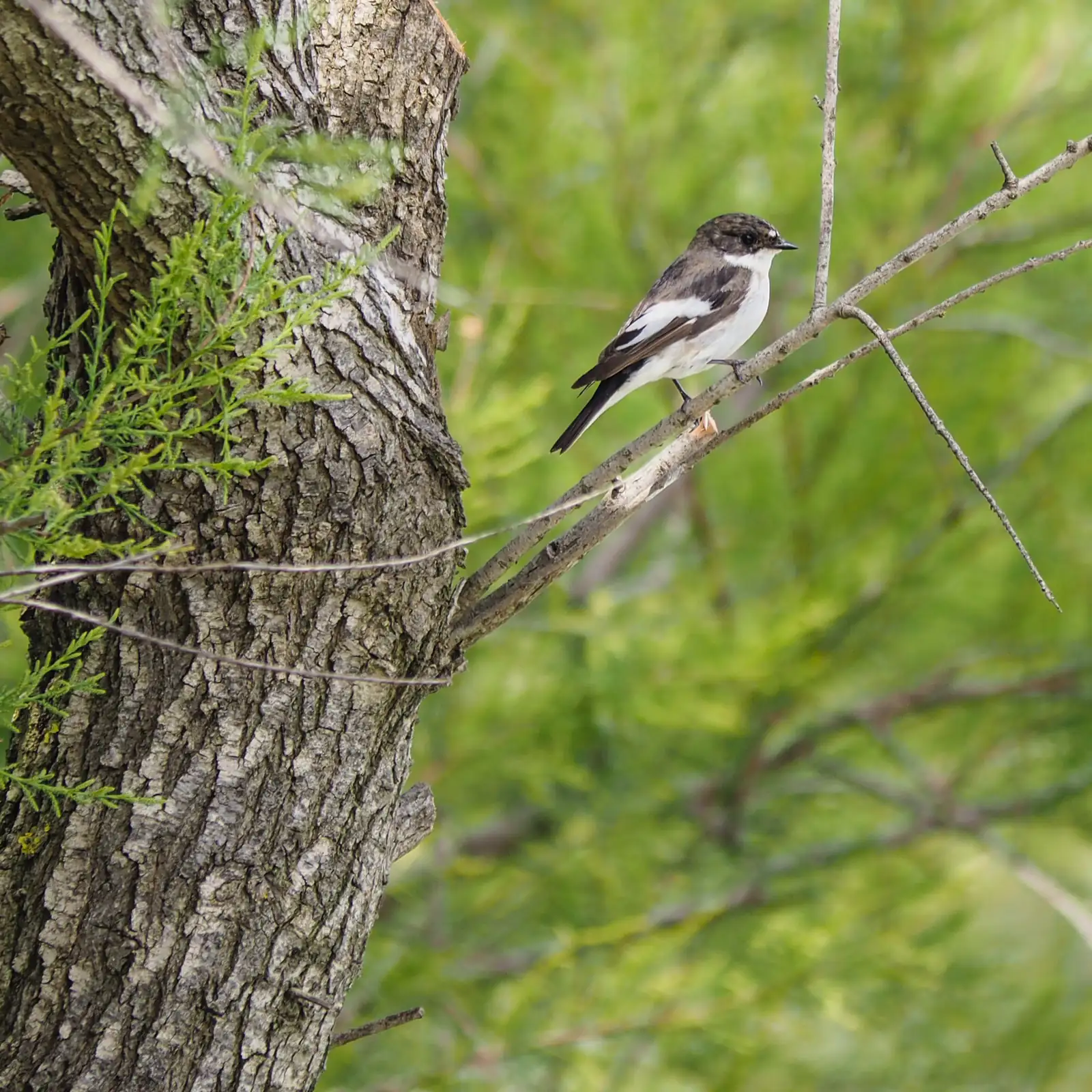
A male Pied Flycatcher can show a bold contrast between dark upperparts, pale underparts and a white wing patch. Females are browner, so the familiar black-and-white picture does not cover every bird you may encounter. Begin with the overall size and pattern, then check the wing marking when a bird turns. A brief pale flash between leaves deserves another look before it becomes a confident identification.
Our approach is to pause where the public path gives an open view across several branches. Let movement draw your attention, then raise binoculars smoothly rather than constantly scanning a narrow patch at high magnification. When a bird returns to a visible perch, compare its posture and plumage over more than one view. Stay with the bird’s ordinary activity instead of trying to discover where it is taking food.
Pied Flycatchers are strongly associated with western breeding woods, while migration brings them to other places. BTO identifies Welsh oak woodland as a stronghold and describes autumn passage involving continental birds. Keep that distinction in your notes: the place and date help explain the encounter. A bird on a coastal scrub path in September should not be used to infer a breeding population in the nearby woodland.
How to identify a Redstart
The orange-red tail is the first useful Redstart feature to learn. The RSPB describes the frequent quivering movement, with breeding males showing a dark face, grey upperparts and warm-coloured chest. Females and young birds are browner, but the tail still provides a valuable starting point. Wait for the bird to turn and combine the tail with the rest of its shape and plumage.
Watch from a gap in the public-path view that includes both lower branches and the ground beneath. A bird can appear briefly against one background and then vanish into another without having travelled far. Keep your position and inspect the same area again before moving. That often gives a more relaxed view than following every movement through the trees and repeatedly changing the angle of approach.
For a beginner, a clear Redstart view can be particularly satisfying because it links an obvious colour feature with posture and movement. Make a short note after watching: what first caught your attention, which features confirmed the identification and how long the view lasted. If you only saw the tail, keep that limitation in the note. A useful observation develops from the evidence you had, not from the photograph you hoped to take.
How to find a Wood Warbler by song
Wood Warbler is usually a bird to listen for before searching the canopy. The RSPB likens its characteristic song to a spinning coin. Learn that sound before travelling and practise separating it from the surrounding woodland chorus without playing recordings outdoors. When you hear a likely bird, stop walking and work out the direction, then wait for movement within the visible branches.
The combination of yellow on the throat and upper breast with a clean pale underside can help confirm a view. Foliage and changing light can make a small green-and-yellow bird surprisingly difficult to follow, so use the whole pattern rather than one bright patch. Keep binoculars ready at a comfortable height and allow the bird to come into an open part of the canopy on its own.
The RSPB describes a western woodland distribution and identifies several reserves where Wood Warblers may be seen, while BTO describes a substantial long-term decline. Give a quiet encounter time and space. If a bird stops singing or disappears, wait without trying to stimulate another response. An unhurried listening session from an established trail protects the experience for both the bird and the next visitor.
Plan a morning that gives all three birds a chance
Choose a short main route and two or three places where you can stand without blocking anyone. At each pause, listen first, locate the source of one sound and then look. When several birds are singing, resist switching target every few seconds. Following a single bird long enough to understand its position and behaviour is more productive than repeatedly losing three different sounds.
Carry binoculars, a simple field guide or saved identification notes, and clothing that is comfortable during a stationary watch. Our preference is to leave a heavy telescope behind unless the wider reserve itinerary needs it. A phone recording of the whole soundscape can help with later learning where the operator permits it, but it should not become a reason to approach a singer or disclose a sensitive breeding position.
Allow a second pass along the same path after a break. Familiarity makes small movements easier to notice, and a different angle of light can reveal details hidden earlier. If nothing new appears, enjoy the ordinary woodland birds instead of expanding the search into unmarked habitat. Returning another morning often offers a better lesson than pushing farther when concentration and patience have gone.
Watch breeding woodland birds responsibly
Nestboxes and natural cavities belong to the birds and the people authorised to monitor them. Do not inspect an entrance, open a box or wait close beside it for adults to arrive. A photograph of a freely feeding bird from the path can be just as rewarding. If adults hesitate with food or repeatedly alarm, withdraw quietly and let them resume their activity.
Keep group sizes and conversation low enough for everyone to hear. Where the path narrows, move to an established stopping place and leave room for walkers to pass. Follow the reserve’s current dog rules and avoid cutting across the woodland floor, where plants and less visible wildlife are easily damaged. These decisions improve the quality of the watch as well as protecting the habitat.
Finish with a modest account of the morning: the securely identified species, general public trail, date and conditions. For the next visit, choose one skill to improve, such as recognising Wood Warbler song or following a female Pied Flycatcher through foliage. The woodland habitat and listening lessons below help extend that learning, while the reserve guide supplies the practical details for your chosen destination.
Where to see western oakwood birds by month
The months below come from each reserve’s local birding guide. They describe typical presence or a preferred watching season; national occurrence can be broader. Reports show past observations and cannot promise an encounter. Sensitive birds have no published watching position.
| Species | Reserve guide | Typical or preferred months |
|---|---|---|
| Redstart | RSPB Loch Garten | April, May, June, July, August |
| Pied Flycatcher | RSPB Ynys-hir | April, May, June, July |
| Redstart | RSPB Ynys-hir | April, May, June, July, August |
| Redstart | RSPB Dungeness | April, May, August, September |
| Pied Flycatcher | RSPB Lake Vyrnwy | April, May, June, July, August |
| Pied Flycatcher | RSPB Gwenffrwd-Dinas | April, May, June, July, August |
| Redstart | RSPB Gwenffrwd-Dinas | April, May, June, July, August, September |
| Wood Warbler | RSPB Gwenffrwd-Dinas | April, May, June, July, August |
| Pied Flycatcher | RSPB Carngafallt | April, May, June, July, August |
| Redstart | RSPB Carngafallt | April, May, June, July, August, September |
| Wood Warbler | RSPB Carngafallt | April, May, June, July, August |
| Redstart | RSPB Insh Marshes | April, May, June, July, August |
| Redstart | RSPB Pulborough Brooks | August, September |
| Pied Flycatcher | RSPB Coombes Valley | April, May, June, July, August |
| Redstart | RSPB Coombes Valley | April, May, June, July, August, September |
| Redstart | Gibraltar Point National Nature Reserve | April, May, August, September |
| Pied Flycatcher | RSPB Nagshead | April, May, June, July |
| Redstart | RSPB Nagshead | April, May, June, July |
| Wood Warbler | RSPB Nagshead | April, May, June, July |
| Wood Warbler | Bwlch Nant yr Arian | May, June, July |
| Redstart | RSPB Haweswater | April, May, June, July, August, September |
| Pied Flycatcher | RSPB Haweswater | April, May, June, July, August |
| Pied Flycatcher | RSPB Wood of Cree | April, May, June, July, August |
| Redstart | RSPB Wood of Cree | April, May, June, July, August, September |
| Wood Warbler | RSPB Wood of Cree | April, May, June, July, August |
| Pied Flycatcher | RSPB Inversnaid | April, May, June, July, August |
| Wood Warbler | RSPB Inversnaid | April, May, June, July, August |
| Redstart | RSPB Inversnaid | April, May, June, July, August |
| Redstart | Farlington Marshes | April, May, August, September |
| Redstart | RSPB Sherwood Forest | April, May, June, July, August, September |
| Wood Warbler | Beinn Eighe National Nature Reserve | May, June, July, August |
| Redstart | Beinn Eighe National Nature Reserve | April, May, June, July, August |
| Pied Flycatcher | Isles of Scilly | April, May, August, September, October |
Reserve guides for western oakwood birds
- RSPB Loch Garten · Scotland
- RSPB Ynys-hir · Wales
- RSPB Dungeness · England
- RSPB Lake Vyrnwy · Wales
- RSPB Gwenffrwd-Dinas · Wales
- RSPB Carngafallt · Wales
- RSPB Insh Marshes · Scotland
- RSPB Pulborough Brooks · England
- RSPB Coombes Valley · England
- Gibraltar Point National Nature Reserve · England
- RSPB Nagshead · England
- Bwlch Nant yr Arian · Wales
- RSPB Haweswater · England
- RSPB Wood of Cree · Scotland
- RSPB Inversnaid · Scotland
- Farlington Marshes · England
- RSPB Sherwood Forest · England
- Beinn Eighe National Nature Reserve · Scotland
- Isles of Scilly · England
Sources and review
Reviewed 2026-10-19.
- BTO Pied Flycatcher: western woods and April–October migration timing
- BTO Redstart: April arrival and early-autumn departure
- BTO Wood Warbler: mid-April arrival and scarce autumn passage
- RSPB Pied Flycatcher: male/female identification and reserve choices
- RSPB Redstart: tail, plumage and movement
- RSPB Wood Warbler: song, plumage and western woodland reserves
- RSPB Gwenffrwd-Dinas: woodland habitats and birds
- RSPB Coombes Valley: spring and early-summer birds
- RSPB Inversnaid: Atlantic oakwood and route demands