
Responsible wildlife guide
Where to see Choughs in the UK
Look for Choughs around suitable western coasts, especially short coastal grassland and the air above cliffs. They are resident, so choosing the right place and a comfortable public viewpoint matters more than waiting for a narrow summer season.
When is the best time to see Choughs?
Choughs can be watched throughout the year in the parts of Britain where they live. That makes them a useful target for a western coastal holiday outside the busiest seabird season. Our choice for a first attempt is a day with good visibility, manageable wind and enough time to revisit the same public grassland view. There is less value in choosing a supposedly perfect date if the route is uncomfortable or the weather prevents a steady watch.
Spring brings the added interest of birds calling and moving around breeding landscapes, but concentrate on foraging and flight. A pair disappearing behind a cliff does not create a reason to investigate. In autumn and winter, the RSPB notes that Choughs can gather in flocks. Those groups can make behaviour particularly rewarding: watch how birds spread across feeding ground, then lift and circle together before settling elsewhere.
Plan a modest circuit with a few long pauses. If a group leaves the visible grass, continue your walk and return later rather than following across the turf. On a family visit, alternating a stationary birdwatch with a sheltered break usually gives everyone more patience. Keep the route back in mind on short winter days, especially where the final approach crosses exposed heath or uneven coast path.
How to identify a Chough
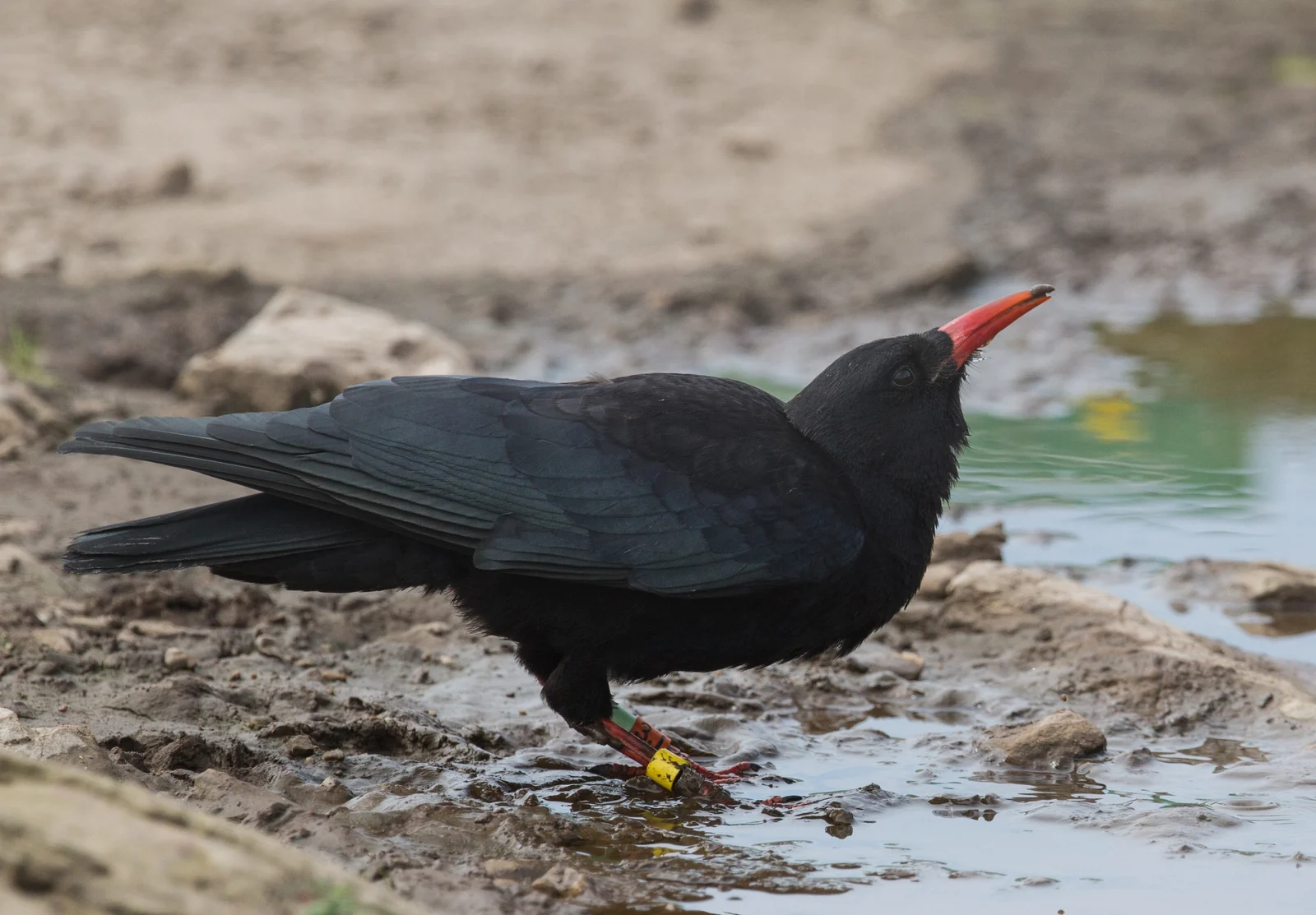
An adult Chough combines glossy black plumage with red legs and a long, curved red bill. These features are more useful than simply deciding that a bird looks like a small crow. Use binoculars to compare the head profile when a bird turns sideways, and wait for an unobstructed view of the legs before making a confident identification. Strong sunlight and shadow can alter how obvious the colour appears.
At a distance, Jackdaws can cause confusion, particularly when both species are flying above coastal cliffs. BTO describes the Chough as slimmer and more acrobatic than many other crows. Watch the whole flight rather than one blurred wingbeat: a sustained view gives a better impression of shape, manoeuvrability and the way birds use the air. Add the bill and leg details when they land, instead of letting an exciting display settle the identification alone.
Listening helps keep track of a group that disappears against rock or dark vegetation. Learn the Chough’s call before the trip using the recordings linked by BTO or the RSPB, then compare what you hear outdoors with the birds you can actually see. Keep your phone silent on the path. If a distant call remains uncertain, enjoy the encounter and make a short note of what was visible rather than forcing a name.
Where to look: feeding grassland and public cliff views
The feeding habitat is central to choosing a useful watch. Choughs take invertebrates from the ground, including soil and dung, and the National Trust explains the importance of short grass. Look across suitable grazed areas from an existing path before concentrating all your attention on the cliff face. A bird walking and probing can be less conspicuous than one flying overhead, but the longer view is often more informative.
Begin with the nearest visible patch and work outwards. Check behind small rises and along the edge of the short vegetation, allowing birds to emerge in their own time. Once you find a group, keep enough space to see natural feeding: the repeated probing, a brief pause to look around and the change from walking to flight. If heads stay raised because of your presence, retreat and let the group settle.
A telescope is useful when the feeding ground lies well beyond the path, although binoculars are easier for tracking birds crossing a wide sky. Our preference is to carry the lighter setup unless the reserve guide identifies a long view that makes a scope worthwhile. Remain behind barriers and avoid moving towards an edge for a clearer angle. Choose a second official view if foreground vegetation blocks the first.
South Stack, Ramsey or a mainland coastal walk?
South Stack is our choice for combining a Chough attempt with a broader mainland seabird day on Anglesey. The RSPB specifically describes Choughs there all year, alongside the reserve’s cliff and heathland setting. Give the grassland and the air above the cliffs attention as well as the auk ledges. Use the South Stack guide to distinguish the visitor areas and walks before choosing a route that suits your party.
Ramsey offers an island setting in Pembrokeshire and is named by the RSPB as a place where its habitat management helps Choughs. Choose it when the boat journey and the rest of the island experience suit your plans. Read the Ramsey guide before booking, especially the difference between a landing and a cruise. Allow for weather disruption and keep a mainland day available so the whole holiday does not depend on one sailing.
For Cornwall, the National Trust’s Chough information and Lizard visitor advice are useful starting points. In western Scotland, choose a guide with an established Chough target rather than assuming every dramatic Hebridean cliff holds them. The species’ range is localised. Compare the linked guides for the actual public watching places, then select the destination that gives you time to wait comfortably rather than attempting several distant headlands in a day.
What a good Chough watch can teach you
Set yourself a behaviour question before trying for a close photograph. Are the birds feeding together or apart? Do they remain in short turf or work along an edge? Which part of the landscape do they use after taking off? A quiet period spent answering one of these questions gives the visit a purpose even when the birds stay beyond camera range. Make notes from the path after the group has moved on.
Repeat the same circuit at another time of day if the rest of your itinerary allows. Different light can make a dark bird easier to follow across grass, while changes in wind can alter which viewpoints feel comfortable. Neither change guarantees a better result, so keep the second session short and flexible. A familiar patch can be easier to read than a new headland where most of the visit goes into finding your bearings.
The bird’s relationship with grazed habitat also helps explain why conservation work can look like ordinary farming. Short vegetation and suitable feeding ground need continuing management. Observe livestock from a respectful distance, leave gates as instructed and keep dogs under the reserve’s rules. Supporting the place you visit and giving feeding birds room are practical contributions that fit naturally into an enjoyable coastal day.
Plan the rest of the day around the coast
Pack for time spent standing still, with a windproof layer and binoculars you can hold comfortably. Read the reserve guide for surfaces, gradients, facilities and transport rather than assuming all cliff viewpoints are equally straightforward. If steps, uneven ground or a long exposed return are a concern, choose a shorter official viewpoint and allow more observation time there.
Build a second interest into the visit: heathland birds, the mixed seabird colony or a sheltered landscape walk. Choughs move around their feeding areas, and a flexible day gives you a reason to remain in the right landscape without pursuing a group. Use the sea-cliff and grassland pages below to broaden the plan, then return to the guide for the details that determine whether the day works for you.
Where to see choughs by month
The months below come from each reserve’s local birding guide. They describe typical presence or a preferred watching season; national occurrence can be broader. Reports show past observations and cannot promise an encounter. Sensitive birds have no published watching position.
| Species | Reserve guide | Typical or preferred months |
|---|---|---|
| Chough | Skomer Island | January, February, March, April, May, June, July, August, September, October, November, December |
| Chough | RSPB South Stack | January, February, March, April, May, June, July, August, September, October, November, December |
| Chough | RSPB Ramsey Island | April, May, June, July, August, September, October |
| Chough | RSPB The Oa | January, February, March, April, May, June, July, August, September, October, November, December |
| Chough | Bardsey Island and Bird Observatory | January, February, March, April, May, June, July, August, September, October, November, December |
| Chough | Skokholm Island | April, May, June, July, August, September |
Reserve guides for choughs
- Skomer Island · Wales
- RSPB South Stack · Wales
- RSPB Ramsey Island · Wales
- RSPB The Oa · Scotland
- Bardsey Island and Bird Observatory · Wales
- Skokholm Island · Wales
Sources and review
Reviewed 2026-10-19.