
Responsible wildlife guide
Caledonian pinewood birds: Crested Tits and crossbills
Choose a Scottish pinewood reserve with public trails, walk slowly and listen before searching the canopy. Crested Tits are a realistic focus for a rewarding forest day; Scottish Crossbill identification needs considerable care. Capercaillie is protected and must not be sought.
Where to see Caledonian pinewood birds
Begin with the habitat and the walk you can comfortably enjoy. The RSPB identifies Loch Garten, Abernethy and Corrimony among places associated with both Crested Tit and Scottish Crossbill. These are sensible destinations to compare before looking for individual reports. Our choice for a first pinewood day is a reserve with a clear public route and somewhere to ask about current conditions. Use its guide for the approach, opening arrangements and any seasonal restrictions.
Crested Tits have a restricted British range in northern Scotland. BTO places the core around Strathspey and the pinewoods and plantations of Moray and Nairn, with further scattered populations. A conifer plantation elsewhere in Britain does not become a Crested Tit destination simply because the trees look suitable. Choose a locally supported reserve, then give its public paths time. The broader landscape can be enjoyed without turning every stand of trees into a search site.
When is the best time for a pinewood birding trip?
Both headline birds are resident, so there is room to fit a visit around a wider Scottish holiday. Winter offers a different woodland experience from spring: BTO describes Crested Tits joining other tit species in feeding flocks. Our winter preference is a settled day with enough daylight for pauses and an easy return. A frosty photograph may look appealing, but it says little about the state of a forest road or your ability to stand comfortably.
Spring and summer bring a fuller forest day, with other wildlife to enjoy along the public route. Loch Garten’s operator describes Crested Tits alongside Siskins, Great Spotted Woodpeckers and Red Squirrels. Decide whether you want a quiet listening walk or a visit incorporating the Nature Centre, and check the guide accordingly. In any season, shortening the walk when the weather worsens is a sound choice. Repeated visits in manageable conditions are more useful than one exhausted attempt to cover a whole forest.
How to recognise a Crested Tit
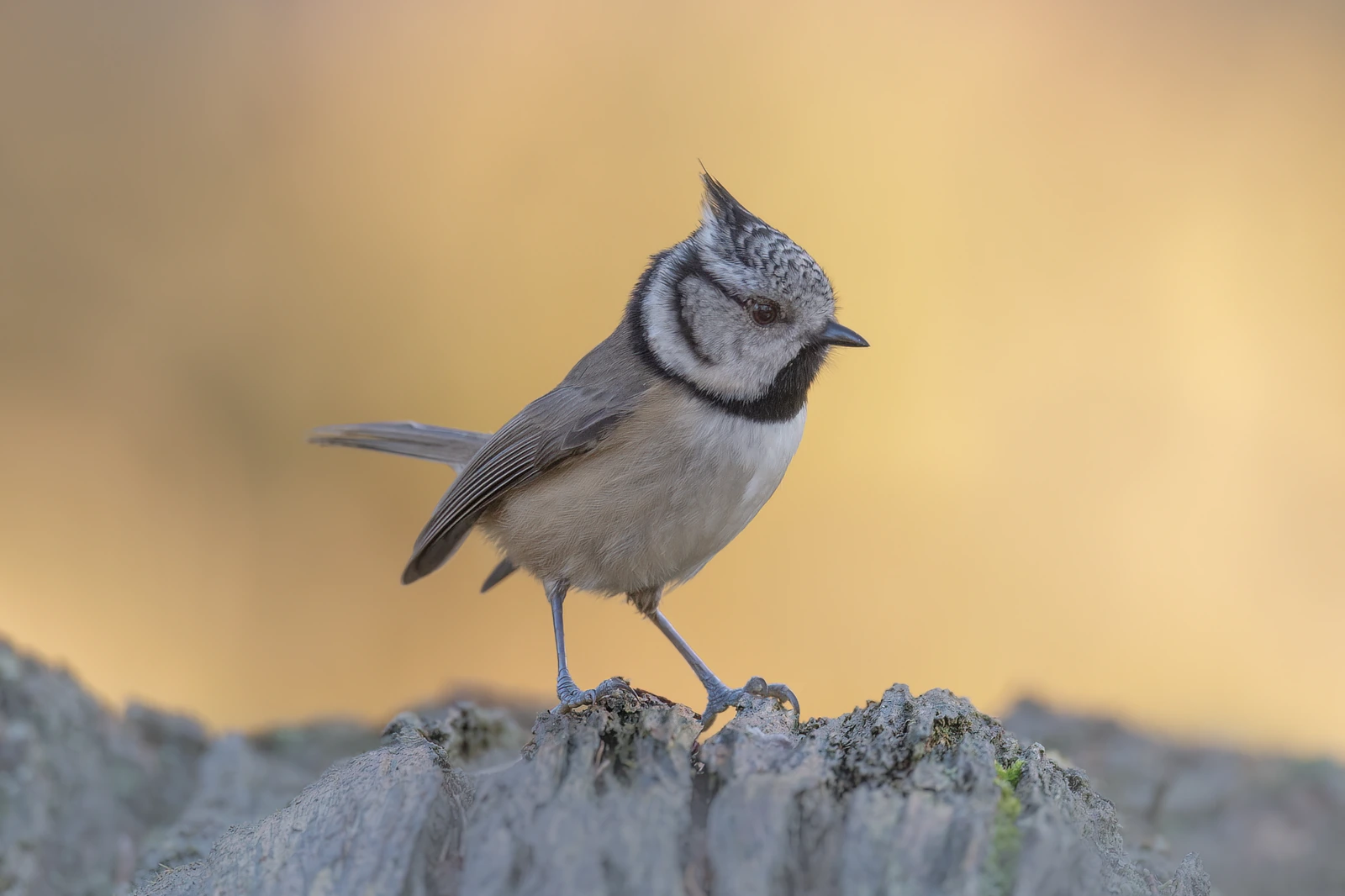
The head is the useful starting point: a pointed black-and-white crest and a strongly marked face distinguish Crested Tit from the more familiar tits. The crest can flatten, so wait for another view rather than relying on a single outline. Watch an active bird as it moves between branches, then compare the head markings when it pauses. Binoculars are usually easier to use in this situation than trying to keep a small moving bird inside a scope.
Listen first, then find the bird producing the sound. Learn the call privately before the walk, with headphones or at home, and keep the phone quiet in the forest. When a mixed flock passes, look through its members carefully without rushing after it into vegetation. A glimpse may remain unresolved; note the features you actually saw. Letting the flock move naturally gives other visitors a chance to watch and avoids turning a pleasant encounter into a pursuit.
Can you identify a Scottish Crossbill by sight?
Scottish Crossbill is a much harder identification. The RSPB stresses its similarity to other crossbills, while BTO explains that reliable separation depends on subtle bill measurements or diagnostic calls. Location within Scotland, a bulky head or a photograph labelled by an app is insufficient on its own. Our advice is to enjoy a crossbill encounter fully and use a cautious name unless the evidence supports something more precise. There is no need to force every bird onto a life list.
Watch feeding, posture and movement from the path, writing down what you can support. If a bird calls naturally, a short passive recording may be useful to an experienced assessor; do not provoke a response with playback or follow it to obtain a better recording. Ask a knowledgeable local guide about identification standards rather than assuming that a promised species can always be distinguished during a brief walk. Common Crossbill is a worthwhile bird in its own right, and an unidentified crossbill can still be an excellent observation.
Why Capercaillie must not be sought
Capercaillie belongs in the story of these forests because its conservation affects how people use them. It is not a search target for this trip. The RSPB explicitly asks visitors not to look for this highly disturbance-sensitive bird. Respect current path advice, seasonal restrictions and any requests about dogs. Avoid sharing precise encounter positions or assembling a route from old reports; the responsible response to vulnerable wildlife is to reduce attention, even when an online account makes a location sound accessible.
If you meet a Capercaillie unexpectedly, give it space and withdraw quietly rather than gathering people for photographs. Continue only in accordance with the operator’s advice, and pass a useful observation privately to the reserve if requested. Forest birding offers plenty to study without this encounter. A day of tit calls, feeding finches and changing light through Scots Pines is complete on its own. Plan companions’ expectations before arriving so nobody feels pressure to search for a protected bird at the end.
What equipment helps in Scottish pinewoods?
Choose binoculars you can hold steadily and raise quickly. A waterproof layer, comfortable footwear and warm spare clothing make patient stops easier; the route guide should decide what surfaces and distances you prepare for. Carry the map so the return is clear when attention shifts between calls and treetops. A scope can be useful for a distant stationary bird, but for our first forest walk we would prioritise manageable binoculars and freedom to listen over carrying every optical option.
Use a notebook to separate observation from conclusion: head pattern, bill shape, call quality, behaviour and what blocked the view. Try sketching the bird’s outline before consulting an image, especially with crossbills. This keeps a remembered photograph from replacing what you saw. Choose a broad aim for the session, such as following one mixed flock from the public route. It gives the walk purpose while leaving room for common woodland species and the possibility that the specialist remains out of sight.
How to build a rewarding pinewood day
Give one suitable reserve a generous part of the day, then decide on another stop only after considering weather and energy. The linked guides show which watching places are public and how their routes work. Pair the forest with a contrasting habitat if your party wants variety, rather than driving between several pinewoods after every new report. A relaxed base in the region makes it easier to return in a different light or listen again when the wind drops.
Before leaving, revisit your notes and mark any identification that remains uncertain. Share unusual records through the appropriate recorder with the supporting evidence, keeping sensitive locations private. Look through the woodland fieldcraft lessons before the next visit: learning how to pause, hear a call and pick up a small bird is transferable to ordinary woods near home. That practice makes a future Scottish trip richer, whether the day’s highlight is a Crested Tit or simply understanding a familiar flock better.
Where to see caledonian pinewood birds by month
The months below come from each reserve’s local birding guide. They describe typical presence or a preferred watching season; national occurrence can be broader. Reports show past observations and cannot promise an encounter. Sensitive birds have no published watching position.
| Species | Reserve guide | Typical or preferred months |
|---|---|---|
| Crested Tit | RSPB Loch Garten | January, February, March, April, May, June, July, August, September, October, November, December |
| Scottish Crossbill | RSPB Loch Garten | January, February, March, April, May, June, July, August, September, October, November, December |
| Crested Tit | RSPB Corrimony | January, February, March, April, May, June, July, August, September, October, November, December |
| Scottish Crossbill | RSPB Corrimony | January, February, March, April, May, June, July, August, September, October, November, December |
Reserve guides for caledonian pinewood birds
- RSPB Loch Garten · Scotland
- RSPB Corrimony · Scotland
Sources and review
Reviewed 2026-10-19.